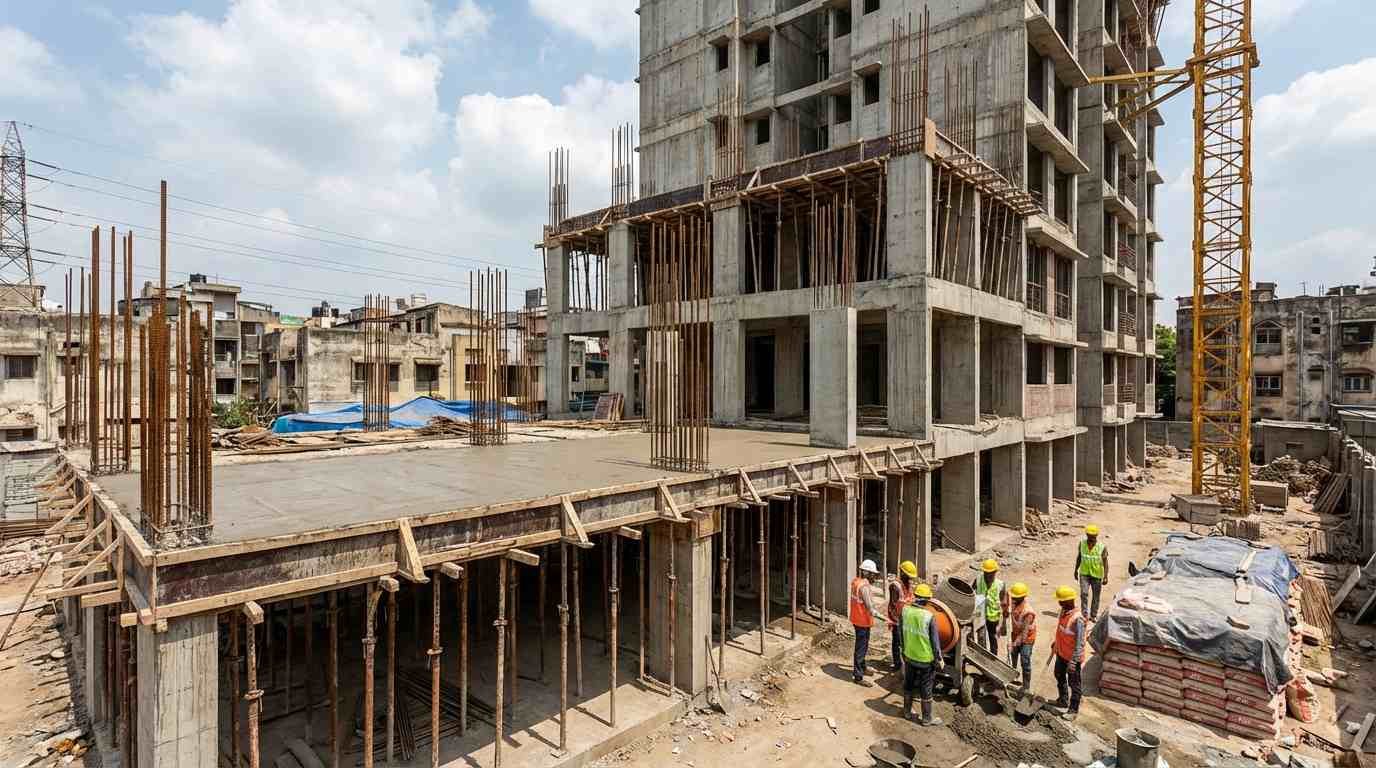
Building with Reinforced Cement Concrete (RCC) remains the gold standard for durable, earthquake-resistant structures across India, with costs in 2026 ranging from ₹180 to ₹400 per square foot depending on location, grade of concrete, and structural complexity. Understanding these cost components helps homeowners, builders, and contractors plan budgets accurately and avoid expensive surprises during construction.
Understanding RCC Structure Construction Cost
RCC construction cost encompasses all expenses related to structural elements including slabs, beams, columns, and foundations made from reinforced cement concrete. The total cost per square foot includes raw materials (cement, steel, sand, aggregates), labor charges, shuttering materials, and equipment rental. In metropolitan cities like Mumbai and Delhi, premium-grade concrete (M30+) with Fe500 steel pushes costs toward ₹300-₹400 per sq ft, while tier-2 cities maintain more economical rates of ₹160-₹250 per sq ft for standard residential work.
The national average for RCC work in 2026 stands at approximately ₹195-₹280 per square foot for typical residential construction, with regional variations driven by local material availability, transportation costs, and prevailing wage rates. This cost covers the complete structural framework but excludes finishing work like plastering, flooring, electrical, and plumbing installations.
| Cost Component | Price Range (₹/sq ft) | Percentage of Total |
|---|---|---|
| Steel Reinforcement | ₹40-₹60 | 25-30% |
| Cement | ₹25-₹40 | 15-20% |
| Sand | ₹10-₹20 | 5-8% |
| Coarse Aggregates | ₹15-₹25 | 8-12% |
| Labor Charges | ₹50-₹70 | 30-35% |
| Shuttering/Centering | ₹25-₹35 | 12-15% |
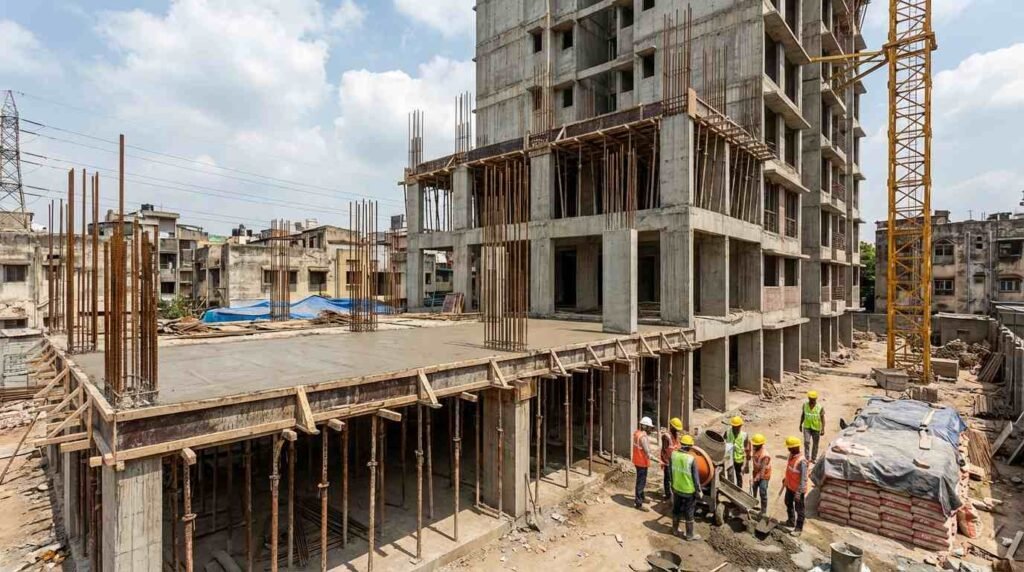
RCC Construction Cost Calculator
RCC Construction Cost Calculator
Calculate accurate estimates for your reinforced cement concrete structure including materials and labor
Project Dimensions
Construction Specifications
Material Cost Breakdown Components
Steel reinforcement forms the most expensive component of RCC construction, consuming 25-30% of total structural costs at ₹40-₹60 per square foot in 2026. Fe500 grade steel bars, now industry standard for residential construction, cost approximately ₹85,000 per ton in metro cities, with typical consumption of 0.944 kg per square foot for standard slabs. Higher steel grades offer better strength-to-weight ratios, reducing overall material requirements while maintaining structural integrity.
Cement costs range from ₹25-₹40 per square foot, with consumption averaging 5 kg per sq ft for typical RCC slab work. Premium Portland Pozzolana Cement (PPC) and ordinary Portland cement (OPC) 53-grade options dominate the market, priced between ₹380-₹420 per 50kg bag depending on region and brand. Bulk purchasing directly from manufacturers can reduce cement costs by 8-12% compared to retail rates.
Fine aggregates (sand) and coarse aggregates (gravel/crushed stone) together account for ₹25-₹45 per square foot of RCC construction. River sand consumption averages 0.175 cubic feet per sq ft at ₹10-₹20, while coarse aggregates require 0.35 cubic feet at ₹28 per sq ft based on 2026 market rates. M-sand (manufactured sand) serves as an eco-friendly alternative to river sand, offering consistent quality at comparable or slightly lower prices.
| Material Type | Quantity per Sq Ft | Unit Rate (₹) | Cost per Sq Ft (₹) |
|---|---|---|---|
| Steel (Fe500) | 0.944 kg | ₹60/kg | ₹56-₹60 |
| Cement (OPC 53) | 5 kg | ₹8/kg | ₹40 |
| Fine Sand | 0.175 cu ft | ₹60/cu ft | ₹10.50 |
| Coarse Aggregate | 0.35 cu ft | ₹80/cu ft | ₹28 |
| Water | 15-20 liters | ₹1/liter | ₹15-₹20 |
Labor and Shuttering Costs
RCC labor costs constitute 30-35% of total structural expenses, ranging from ₹50-₹70 per square foot for residential projects in 2026. This includes skilled masons, bar benders, concrete mixers, and helpers required for mixing, pouring, compacting, and curing operations. Metro cities pay premium wages of ₹1,200-₹1,500 per day for skilled masons compared to ₹600-₹900 in tier-2 cities, directly impacting per-square-foot rates.
Shuttering or formwork costs add ₹25-₹35 per square foot, covering plywood sheets, props, beams, and dismantling charges. Reusable steel or aluminum shuttering systems reduce per-project costs for builders undertaking multiple floors or repeated designs, though initial investment remains higher. Timber shuttering, while economical for single-use applications, requires skilled carpentry and generates more waste compared to modern alternatives.
Labor charges vary significantly based on structural complexity, floor height, and accessibility. Ground floor RCC work costs 15-20% less than upper floors due to easier material transport and simpler formwork requirements. Buildings exceeding three stories typically require concrete pumps or mechanical hoists, adding ₹15-₹25 per cubic meter to labor expenses.
| Labor Category | Daily Wage (Metro) | Daily Wage (Tier-2) | Per Sq Ft Impact (₹) |
|---|---|---|---|
| Skilled Mason | ₹1,200-₹1,500 | ₹600-₹900 | ₹20-₹25 |
| Bar Bender | ₹1,000-₹1,300 | ₹500-₹800 | ₹8-₹12 |
| Concrete Mixer | ₹900-₹1,200 | ₹500-₹700 | ₹10-₹15 |
| Helpers (per unit) | ₹600-₹800 | ₹400-₹600 | ₹12-₹18 |
Regional Cost Variations Across India
Mumbai and Delhi lead metropolitan pricing at ₹250-₹400 per square foot for complete RCC structural work in 2026, driven by premium steel costs (₹85,000/ton), high-grade ready-mix concrete (₹5,800/m³), and skilled labor shortages. Mumbai’s construction cost specifically ranges ₹2,000-₹3,800 per sq ft for complete residential RCC buildings when including all civil works beyond just structural elements.
Bengaluru and Chennai maintain mid-range pricing at ₹220-₹300 per square foot, benefiting from better cement manufacturing proximity and relatively lower transportation costs. These southern metros offer balanced access to both coastal sand supplies and granite aggregate quarries, stabilizing material costs. Ready-mix concrete availability reduces on-site labor requirements, partially offsetting higher base wages.
Tier-2 cities including Lucknow, Jaipur, Indore, and Coimbatore achieve economical RCC rates of ₹180-₹250 per square foot through lower land costs, accessible local cement (₹380/bag), and competitive labor markets. Rural and semi-urban areas can reduce costs further to ₹160-₹220 per sq ft by using manual mixing, locally sourced aggregates, and traditional timber shuttering. However, quality control becomes critical when foregoing ready-mix concrete and professional supervision.
| City Tier | RCC Cost Range (₹/sq ft) | Key Cost Drivers |
|---|---|---|
| Delhi/Mumbai | ₹250-₹400 | Steel ₹85k/ton, Labor ₹1,500/day, RMC ₹5,800/m³ |
| Bengaluru/Chennai | ₹220-₹300 | Balanced material access, RMC availability |
| Pune/Ahmedabad | ₹200-₹280 | Moderate wages, cement ₹400/bag |
| Tier-2 (Jaipur/Lucknow) | ₹180-₹250 | Local cement ₹380/bag, lower wages |
| Tier-3/Rural | ₹160-₹220 | Manual mixing, basic shuttering |
Concrete Grade Impact on Costs
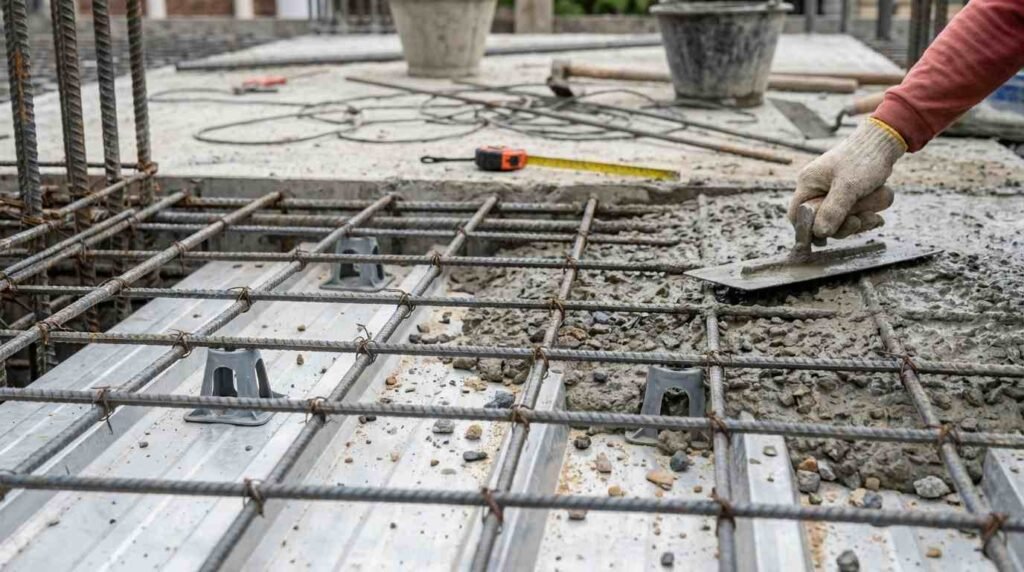
M20 grade concrete represents the most economical option for residential construction, costing ₹4,500-₹7,000 per cubic meter in 2026. This grade suits single to double-storey residential buildings with standard load requirements, offering adequate compressive strength of 20 N/mm² after 28 days. M20 mix uses a 1:1.5:3 ratio (cement:sand:aggregate), balancing economy with structural performance for typical applications.
M25 grade concrete increases costs to ₹5,000-₹8,000 per cubic meter but provides enhanced durability and load-bearing capacity required for multi-storey residential buildings. The improved 1:1:2 mix ratio delivers 25 N/mm² compressive strength, recommended for beams, columns, and slabs in buildings exceeding two floors. Most urban residential construction now specifies M25 as minimum grade to meet updated building codes and ensure longevity.
M30 and higher grades (₹5,500-₹9,000/m³) become necessary for commercial buildings, high-rises, and structures in seismic zones requiring superior strength. These premium mixes demand precise batching, quality aggregates, and often include admixtures to enhance workability and reduce water content. While initial costs run 20-30% higher than M20, long-term maintenance savings and enhanced structural safety justify the investment for critical applications.
| Concrete Grade | Cost per m³ (₹) | Compressive Strength | Recommended Use |
|---|---|---|---|
| M15 | ₹4,000-₹6,000 | 15 N/mm² | Flooring, lean concrete, non-structural |
| M20 | ₹4,500-₹7,000 | 20 N/mm² | 1-2 storey residential, standard slabs |
| M25 | ₹5,000-₹8,000 | 25 N/mm² | Multi-storey residential, beams, columns |
| M30 | ₹5,500-₹9,000 | 30 N/mm² | High-rise, commercial, seismic zones |
| M35 | ₹6,500-₹10,500 | 35 N/mm² | Heavy load structures, bridges |
Cost Optimization Strategies
Bulk material procurement directly from manufacturers reduces cement and steel costs by 8-15% compared to retail purchasing through intermediaries. Establishing relationships with cement plants and steel mills enables builders to negotiate volume discounts and lock in rates for project duration, protecting against market volatility. Coordinating deliveries to minimize storage requirements further reduces material wastage and pilferage losses.
Ready-mix concrete (RMC) eliminates on-site mixing labor, reduces material wastage by 10-15%, and ensures consistent quality through automated batching. While RMC costs ₹200-₹400 more per cubic meter than site-mixed concrete, time savings and reduced labor expenses typically offset the premium for projects exceeding 20 cubic meters. RMC also minimizes sand and cement wastage common in manual mixing operations.
Optimized structural design through professional engineering reduces unnecessary material consumption without compromising safety. Detailed Bar Bending Schedules (BBS) minimize steel wastage by 8-12% through precise cutting lists and strategic reinforcement detailing. Construction Estimator India services provide project-specific quantity optimization, typically saving ₹15-₹25 per square foot through vendor benchmarking and waste reduction strategies.
Reusable shuttering systems amortize costs across multiple uses, reducing per-floor expenses for buildings with repeated floor plans. Aluminum or steel formwork, though costing 3-4 times more initially than timber, pays back within 6-8 reuses while delivering superior finish quality. This approach particularly benefits developers constructing multiple similar units or multi-storey buildings.
| Optimization Strategy | Potential Savings | Implementation Requirement |
|---|---|---|
| Bulk Material Procurement | 8-15% on cement/steel | Direct manufacturer relationships |
| Ready-Mix Concrete | ₹15-₹30/sq ft | Projects >20 m³ volume |
| Professional Design Optimization | ₹15-₹25/sq ft | Structural engineer consultation |
| Detailed Bar Bending Schedule | 8-12% steel wastage reduction | Accurate planning and cutting |
| Reusable Shuttering | 30-40% after 6+ uses | Higher initial investment |
| Off-season Construction | 5-10% labor savings | Flexible project timeline |
Common Cost Escalation Factors
Steel price volatility represents the single largest risk factor for RCC budget overruns, with prices fluctuating ₹5,000-₹8,000 per ton seasonally based on global demand and domestic production. Import duties, raw material (iron ore) costs, and government infrastructure spending directly impact steel rates. Locking in steel prices through advance contracts or phased purchasing helps mitigate this exposure.
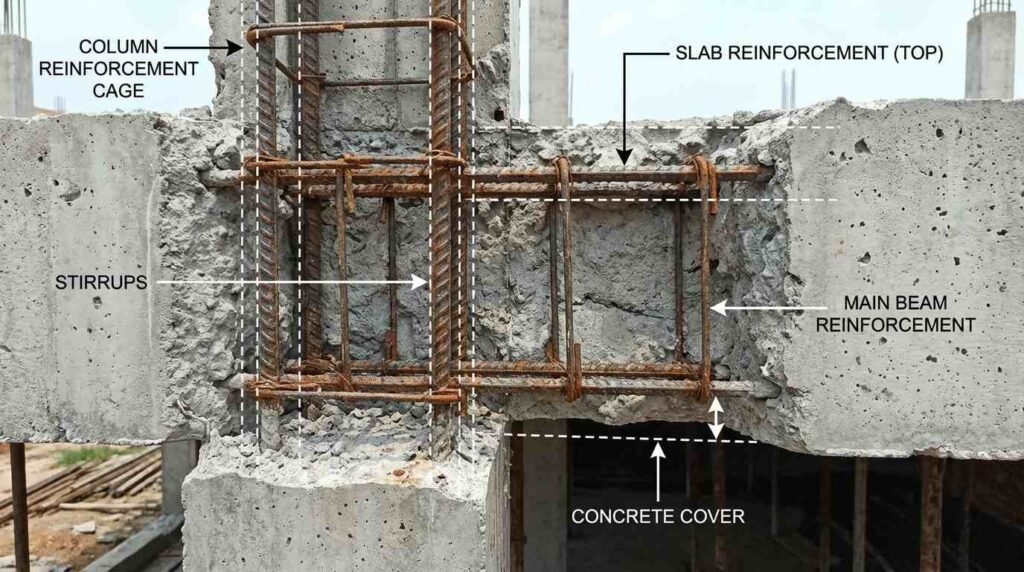
Underestimated structural complexity frequently adds 15-25% to initial RCC cost projections when buildings require deeper foundations, additional columns, or enhanced seismic detailing. Soil testing often reveals poor bearing capacity necessitating pile foundations or raft slabs, substantially increasing per-square-foot costs. Engaging structural engineers during preliminary design prevents costly redesigns during construction.
Hidden labor costs emerge from inefficient site management, extended project timelines, and rework due to quality issues. Extended monsoon breaks can add 10-15% to labor expenses when workers remain on payroll without productive work. Clear contracts specifying completion milestones, quality standards, and payment terms reduce disputes and keep labor costs predictable.
Transportation and logistics for high-rise or remote site construction add ₹20-₹40 per square foot through concrete pumping, material hoisting, and extended supply chains. Sites with restricted access require smaller vehicles and manual handling, increasing labor hours and breakage. Early logistics planning and infrastructure setup minimize these incremental costs.
| Escalation Factor | Typical Impact | Mitigation Strategy |
|---|---|---|
| Steel Price Volatility | ₹10-₹30/sq ft | Lock rates, advance contracts |
| Underestimated Complexity | 15-25% | Professional soil testing, design review |
| Extended Timeline | 10-15% | Clear milestones, weather planning |
| Poor Quality Control | 8-12% rework | Supervision, testing, quality cement |
| Transportation for Height | ₹20-₹40/sq ft | Plan pumps, hoists in advance |
| Material Wastage | 5-10% | Accurate BOQs, site management |
RCC Work for Different Building Elements
Slab construction consumes the largest volume of RCC materials in typical buildings, with 4-6 inch residential slabs costing ₹180-₹250 per square foot including materials and labor. Roof slabs require thicker sections (5-6 inches) to accommodate thermal insulation and waterproofing loads, increasing costs to ₹220-₹280 per sq ft. Cantilevered slabs for balconies demand additional reinforcement, pushing costs 30-40% higher than supported slabs.
Beam construction ranges ₹250-₹350 per square foot of building area, with deeper beams for longer spans requiring proportionally more materials. Main beams supporting multiple floors use M25 or M30 concrete with dense reinforcement cages, while secondary beams can often use M20 grade. Concealed beams integrated within slab depth reduce ceiling heights but increase material consumption and construction complexity.
Column work costs ₹300-₹450 per square foot of column cross-section, varying with height, load, and reinforcement requirements. Ground-floor columns supporting entire building loads require larger cross-sections and denser steel placement than upper-floor columns. Corner and edge columns need additional ties and stirrups for lateral stability, incrementally increasing material costs.
Foundation costs vary dramatically based on soil conditions, ranging from ₹150-₹250 per sq ft for shallow foundations in good soil to ₹400-₹800 per sq ft for pile foundations in poor soil. Raft or mat foundations for even load distribution fall in the ₹250-₹400 per sq ft range, depending on depth and reinforcement density.
| Building Element | Cost Range (₹/sq ft) | Thickness/Depth | Concrete Grade |
|---|---|---|---|
| Ground Floor Slab | ₹160-₹220 | 4-5 inches | M20 |
| Intermediate Floor Slab | ₹180-₹250 | 5-6 inches | M20-M25 |
| Roof Slab | ₹220-₹280 | 5-6 inches | M25 |
| Cantilever Slab | ₹280-₹350 | 6-7 inches | M25 |
| Main Beams | ₹300-₹400 | 12-18 inches deep | M25-M30 |
| Secondary Beams | ₹250-₹320 | 9-12 inches deep | M20-M25 |
| Columns (lower floors) | ₹350-₹450 | 9×12 to 12×18 in | M25-M30 |
| Columns (upper floors) | ₹300-₹400 | 9×9 to 12×12 in | M25 |
| Shallow Foundation | ₹150-₹250 | 3-5 feet | M20 |
| Deep/Pile Foundation | ₹400-₹800 | Varies | M30-M40 |
Quality Control and Testing Costs
Concrete cube testing ensures mix design meets specified strength requirements, costing ₹300-₹500 per set of three cubes tested at 7, 14, and 28 days. Standard practice mandates one test per 5 cubic meters of concrete or per floor, whichever requires more frequent testing. Failed tests necessitate structural assessment and potential remedial measures including jacketing or demolition, making prevention through quality control far more economical.
Steel testing verifies reinforcement bar tensile strength, elongation, and bend properties, costing approximately ₹2,000-₹3,000 per batch test. Testing every 10-15 tons of steel received protects against substandard material that could compromise structural safety. Maintaining mill test certificates and conducting random verification tests balances cost with adequate quality assurance.
Slump tests for concrete workability cost negligible amounts (₹50-₹100) but provide immediate feedback on water content and mix consistency. Conducting slump tests for each concrete batch prevents over-watering that reduces final strength, a common cause of structural deficiencies. Non-destructive testing using rebound hammers (₹500-₹800 per session) can assess existing concrete strength without damaging elements.
Professional site supervision adds ₹15-₹30 per square foot to project costs but typically prevents wastage and quality issues worth 3-5 times that amount. Experienced supervisors ensure proper concrete curing, correct steel placement, adequate cover maintenance, and proper compaction, all critical for long-term structural integrity.
| Quality Control Activity | Cost per Test | Frequency | Purpose |
|---|---|---|---|
| Concrete Cube Test | ₹300-₹500/set | Per 5 m³ or floor | Compressive strength |
| Slump Test | ₹50-₹100 | Each batch | Workability, water content |
| Steel Tensile Test | ₹2,000-₹3,000 | Per 10-15 tons | Material quality |
| Non-Destructive Testing | ₹500-₹800 | As needed | Existing structure assessment |
| Soil Testing | ₹3,000-₹8,000 | Pre-construction | Foundation design |
| Professional Supervision | ₹15-₹30/sq ft | Daily | Overall quality assurance |
Modern RCC Technologies and Costs
Fiber-reinforced concrete (FRC) incorporating steel or synthetic fibers reduces crack formation and improves impact resistance, adding ₹15-₹30 per square foot to conventional RCC costs. FRC particularly benefits thin slabs, industrial floors, and seismic-resistant construction where enhanced ductility justifies the premium. Reduced reinforcement requirements partially offset fiber costs while accelerating construction.
Self-compacting concrete (SCC) flows into formwork without vibration, improving placement speed and finish quality while reducing labor costs by ₹10-₹15 per square foot. SCC’s higher material cost (₹800-₹1,200 extra per cubic meter) pays back through faster construction, reduced noise, and superior consolidation around dense reinforcement. Complex architectural forms and heavily reinforced sections particularly benefit from SCC’s flowability.
Precast concrete elements manufactured off-site reduce on-site labor by 40-50% and accelerate project timelines by 20-30%, though requiring 15-25% premium over cast-in-place costs. Precast slabs, beams, and wall panels suit repetitive designs and tight construction schedules. Transportation and crane requirements limit precast viability to urban areas with good infrastructure and projects exceeding certain scales.
High-performance concrete (HPC) with admixtures achieves superior strength, durability, and impermeability at ₹6,500-₹12,000 per cubic meter. HPC applications include marine structures, chemical plants, and high-rise buildings where extended service life and reduced maintenance justify higher initial investment. Specialized mixing and placement requirements demand experienced contractors familiar with HPC handling.
| Modern Technology | Additional Cost | Key Benefits | Ideal Applications |
|---|---|---|---|
| Fiber-Reinforced Concrete | ₹15-₹30/sq ft | Reduced cracking, impact resistance | Thin slabs, industrial, seismic zones |
| Self-Compacting Concrete | ₹25-₹40/m³ | Faster placement, better finish | Complex forms, dense reinforcement |
| Precast Elements | 15-25% premium | Speed, quality control | Repetitive designs, tight schedules |
| High-Performance Concrete | ₹2,000-₹5,000/m³ extra | Durability, strength | High-rise, marine, industrial |
| Admixtures (plasticizers) | ₹50-₹150/m³ | Workability, strength | All applications |
| Corrosion Inhibitors | ₹100-₹200/m³ | Steel protection | Coastal, high moisture areas |
2026 Market Trends and Outlook
Sustainable construction practices increasingly influence RCC cost structures, with green concrete incorporating fly ash, slag, or recycled aggregates reducing costs by ₹200-₹500 per cubic meter while lowering carbon footprint. Government incentives for green building certifications partially offset any premium for eco-friendly materials. Cement manufacturers now offer blended products specifically formulated for sustainability-focused projects.
Digital estimation tools and Building Information Modeling (BIM) reduce material wastage and planning errors, cutting overall RCC costs by 5-8% through optimized designs. Cloud-based project management platforms improve coordination between architects, engineers, and contractors, preventing costly rework. These technologies, once limited to large commercial projects, now penetrate residential construction through affordable software-as-a-service offerings.
Steel prices stabilized in early 2026 after 2023-2024 volatility, with analysts projecting steady rates through mid-2026 barring major geopolitical disruptions. Domestic production capacity expansions and reduced import dependency strengthen price predictability. However, infrastructure development programs could tighten supply and push rates higher in the second half of 2026.
Labor markets face continuing shortages of skilled RCC workers, particularly masons and bar benders, putting upward pressure on wages. Training initiatives and mechanization through concrete pumps, power trowels, and reinforcement cutting machines partially compensate for labor scarcity. Projects embracing technology and efficient site management maintain cost competitiveness despite wage inflation.
| Trend | Impact on Costs | Timeline |
|---|---|---|
| Green Concrete Adoption | -₹200-₹500/m³ | Already available |
| BIM Implementation | -5-8% overall | Growing adoption |
| Steel Price Stability | Minimal change | Through mid-2026 |
| Labor Wage Inflation | +8-12% annually | Ongoing |
| Mechanization | -₹10-₹20/sq ft | Accelerating |
| Precast Market Growth | -15-20% over cast-in-place | Next 2-3 years |
FAQ’s on RCC Structure construction cost
Q1: What is the average RCC construction cost per square foot in India in 2026?
A1: RCC construction costs in India range from ₹180 to ₹400 per square foot in 2026, depending on location, concrete grade, and structural complexity. Metro cities like Mumbai and Delhi average ₹250-₹400/sq ft, while tier-2 cities range ₹180-₹250/sq ft for residential construction.
Q2: What materials are included in RCC construction cost?
A2: RCC construction cost includes steel reinforcement (₹40-₹60/sq ft), cement (₹25-₹40/sq ft), sand and aggregates (₹25-₹45/sq ft), labor charges (₹50-₹70/sq ft), and shuttering materials (₹25-₹35/sq ft), covering all structural concrete work for slabs, beams, columns, and foundations.
Q3: How much does M25 concrete cost compared to M20?
A3: M25 grade concrete costs ₹5,000-₹8,000 per cubic meter compared to M20 at ₹4,500-₹7,000 per cubic meter in 2026. The 10-15% premium for M25 provides better strength and durability, making it the recommended choice for multi-storey residential buildings and modern construction standards.
Q4: Is ready-mix concrete more expensive than site-mixed concrete?
A4: Ready-mix concrete (RMC) costs ₹200-₹400 more per cubic meter than site-mixed concrete but reduces labor expenses, minimizes material wastage by 10-15%, and ensures consistent quality. For projects exceeding 20 cubic meters, RMC typically offsets its premium through time and waste savings.
Q5: How can I reduce RCC construction costs without compromising quality?
A5: Reduce RCC costs by 8-15% through bulk material procurement, professional structural design optimization, detailed bar bending schedules to minimize steel wastage, using reusable shuttering systems for multi-floor projects, and timing construction during off-peak seasons when labor rates are lower.